
Nailsworth · Cotswolds
A house designed for the slope, the view, and the sun.
Highwoods is a sloping plot above Nailsworth, with a southward outlook across the Cotswold valleys and a fully resolved single-storey home designed specifically for it. The plot is for sale at £350,000 with the complete architectural service of Webster Architecture & Interiors included — a self-build offer with the design problem already solved.
Status
Available — building plot for sale, design included
Brief
238 m² · single-storey 3 bedroom suites, 46 m² deck
Location
Bunting Hill, Nailsworth, GL6
Materials
The Site
The view is what you're really buying.
The site looks, in a photograph, like a problem. A telegraph pole sits on the plot. The grass is rough, the access is awkward, the slope is steep enough that a casual visitor wouldn't immediately see how a house could sit here. Most of what you can see in the site photos is the condition of the land, not what makes it valuable.
Stand on the plot in person and the picture inverts. Highwoods occupies one of the highest points in this part of Nailsworth. The view runs southward across the Cotswold valleys, uninterrupted. The sun arrives early and stays late. Mature woodland on the boundary screens the site without crowding it. A walk through that woodland leads to the local pub in Newmarket — the kind of detail that tells you what life on this plot would actually be like.
The plot also sits adjacent to New Lawn, the current home of Forest Green Rovers FC — which sounds like a problem, and is in fact the opposite. All training is at a separate facility. Matchday activity at this level is infrequent and quiet. The club has approved plans to relocate, and once they leave New Lawn is consented for redevelopment as a low-carbon eco village, with the land immediately to the north of this plot designated as open pasture. The view, the privacy, and the calm here are all future-proofed.
So the design problem isn't really how to build on a difficult slope. It is how to build a house that earns the position — that responds to the gradient, opens to the south, closes to the north, and sits in the landscape rather than on top of it.
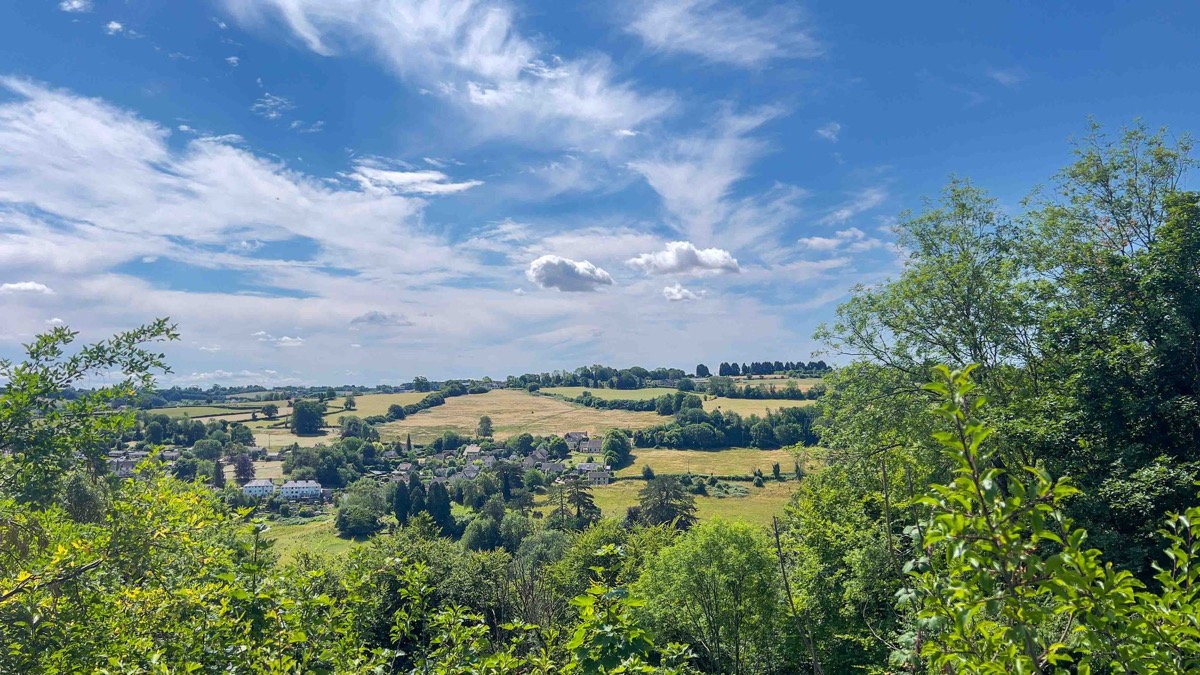
Looking south from the plot. The valley view determines the entire design.
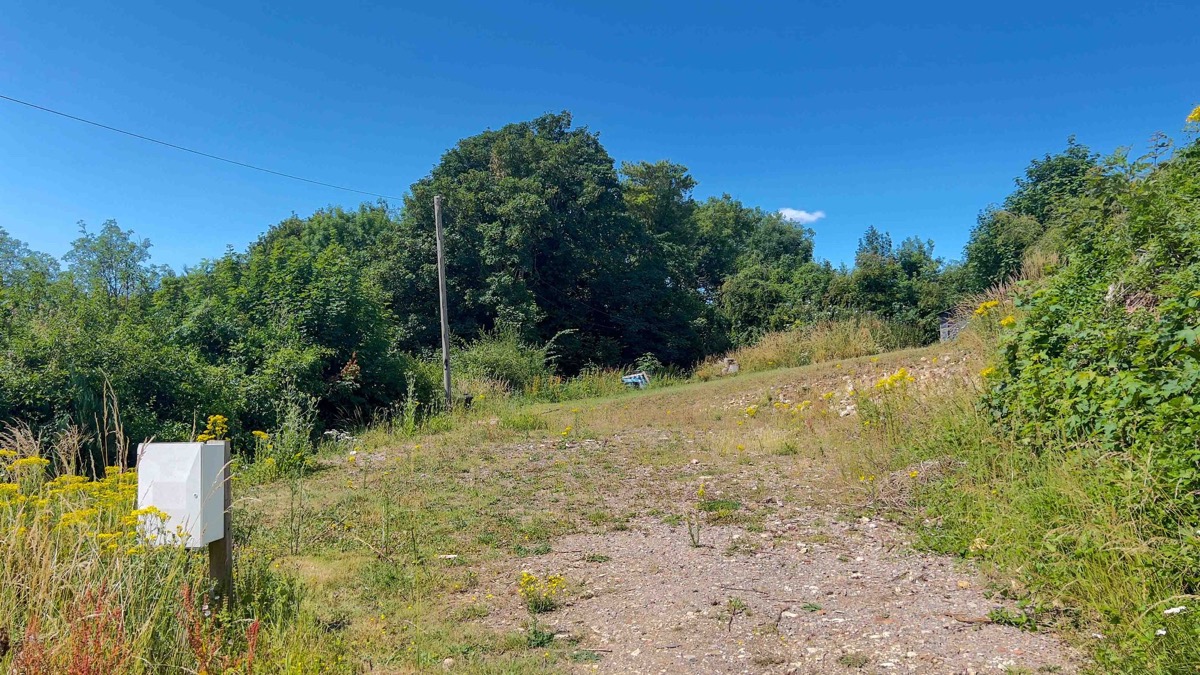

Arrival on the plot: the condition of the land, not the position, is what's important.
Highwoods, Nailsworth, a house designed for the slope, the view, and the sun.
The Response
Sit in the landscape, not on top of it.
The proposed house is single-storey, around 238 m² of internal area, raised on stilts above the natural slope of the hillside. The form runs with the contour rather than fighting it, which keeps the visible mass low and answers the landscape sensitivity of this part of the Cotswolds. Letting the slope flow beneath the building does two things at once: it minimises ground disturbance, and it creates a 46 m² suspended deck off the principal living space that frames the southern view directly.
The materials are deliberately quiet. Stone retaining walls, drawn from the local vernacular, hold the entrance courtyard, the garage, and the upper terrace. Dark vertical timber cladding takes the building above the stone, recedes against the woodland behind it, and matures with the site. Pitched roofs and a single chimney borrow the proportions of the rural Cotswold building tradition without copying its language.
Vehicles are handled at the top of the site. Garage, parking, and arrival sequence are pulled to the road end, so the house itself is left undisturbed in the landscape. Stepped stone walls and planted terraces resolve the level change between drive and house, turning what would otherwise be cost — moving earth — into the entrance experience.
The north elevation is closed. All principal rooms, all main glazing, and the deck face south. This is straightforward Passive House logic applied to the geometry of the site: the elevated position, the southward aspect, and the woodland screening combine to create exceptional conditions for a low-energy home — high solar gain when you want it, deep insulation everywhere else, running costs that will be a fraction of those associated with a conventional new build at this size.
From below. The stone plinth and stepped walls do the work of the slope; the building above sits lightly on top.
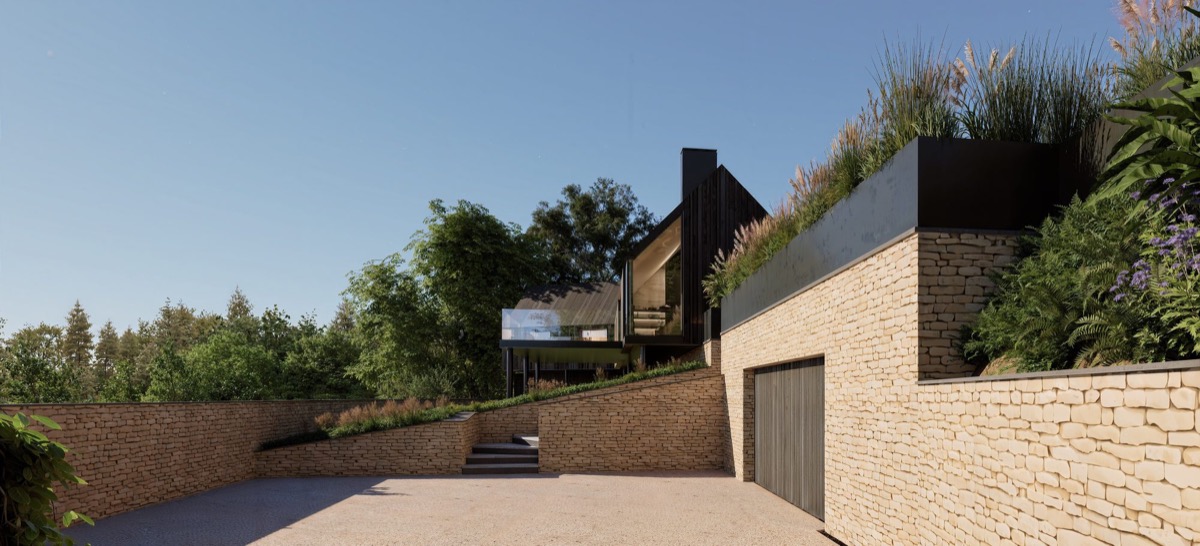
The arrival sequence. Garage and parking are handled at the upper level; the house stays in the landscape.
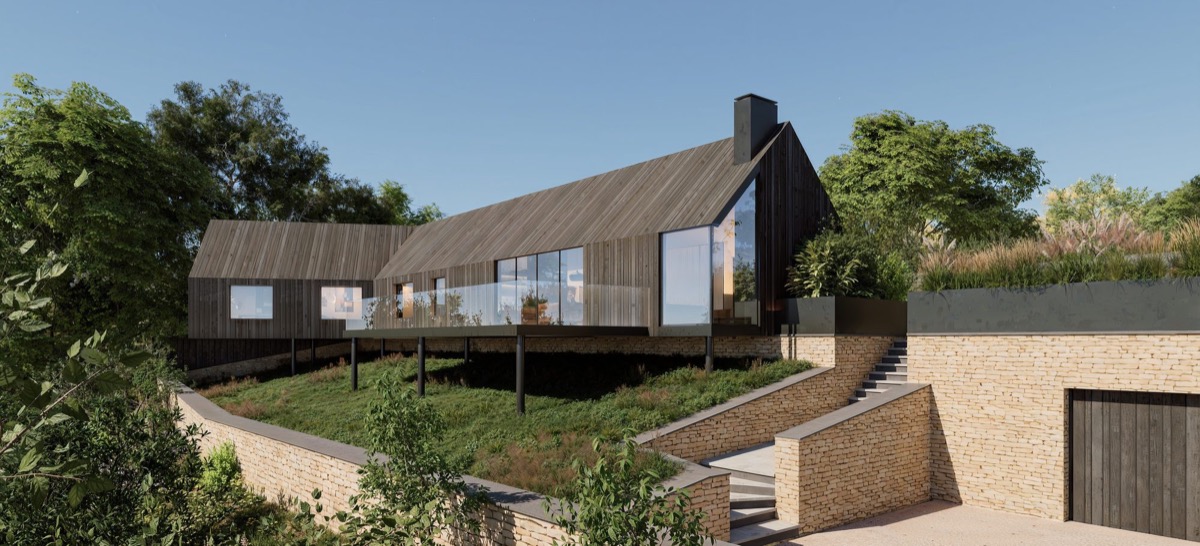
The valley side — full-height glazing on the gable, timber recessed against the trees.
Inside
One room at the heart, three suites at one end, a study at the other.
The plan is organised around a single 59 m² vaulted kitchen, dining and living space at the heart of the house, with floor-to-ceiling glazing onto the deck and the valley beyond. The pitch of the roof gives this room genuine internal volume; the south wall gives it the view. From here the plan stretches west into a wing of three bedroom suites, each with its own bathroom, and east into a study, TV room, utility, cloakroom, and the integral garage.
The materials palette inside continues the discipline of the outside. Pale timber, dark accents, quiet stone, natural light from the south. The cloakroom is the one moment in the house where the design takes a bold decorative position — a deep green tile and warm light — because every house benefits from one room that is unapologetically itself.
The design is intentionally a starting point. Every self-builder has their own vision, and the scheme is intended to be tailored fully to the purchaser's brief, needs, and budget before a fresh planning application is submitted.
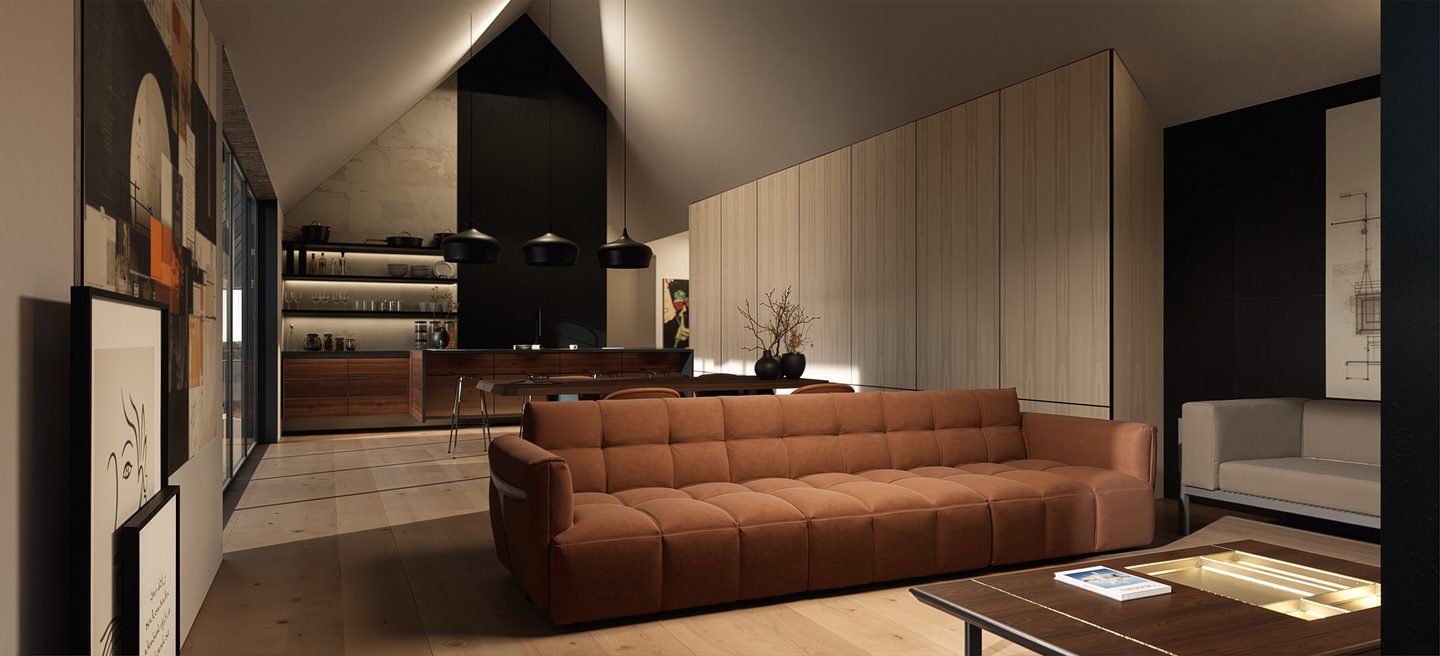
The vaulted living-dining-kitchen space. The roof pitch gives the room its volume; the gable glazing gives it the view.

Looking back from the kitchen toward the fireplace. Pale timber, dark accents, glazing to the south.
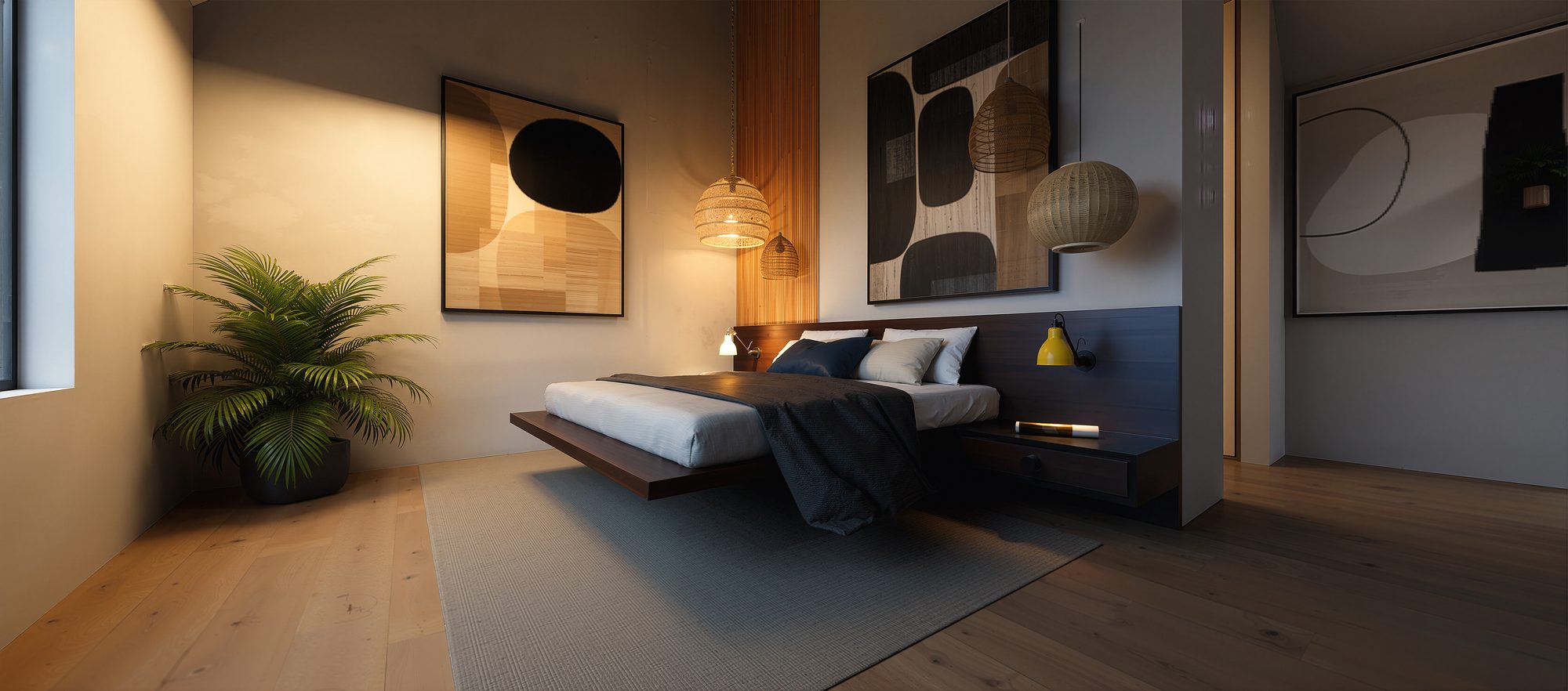
One of three bedroom suites in the western wing.
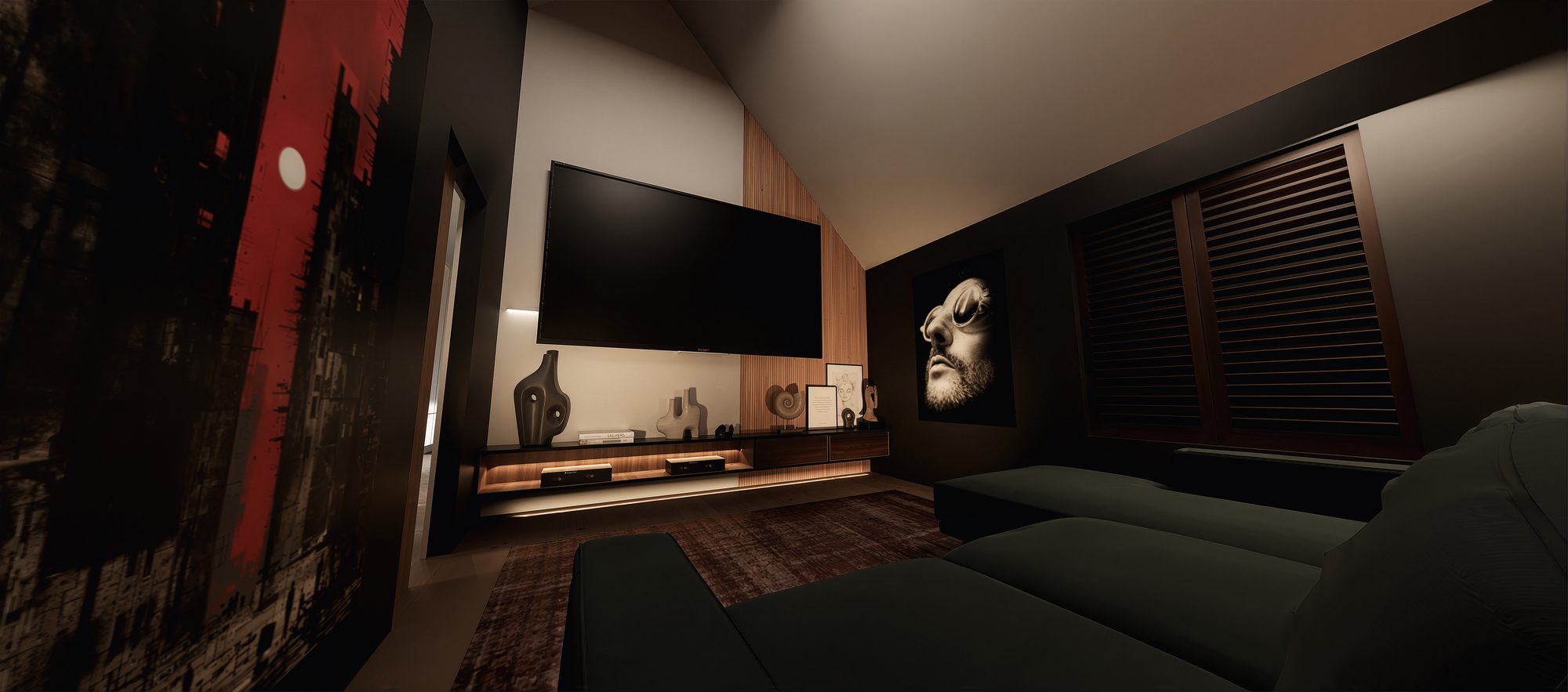
The TV room. A snug at the eastern end of the plan, set apart from the open living space.
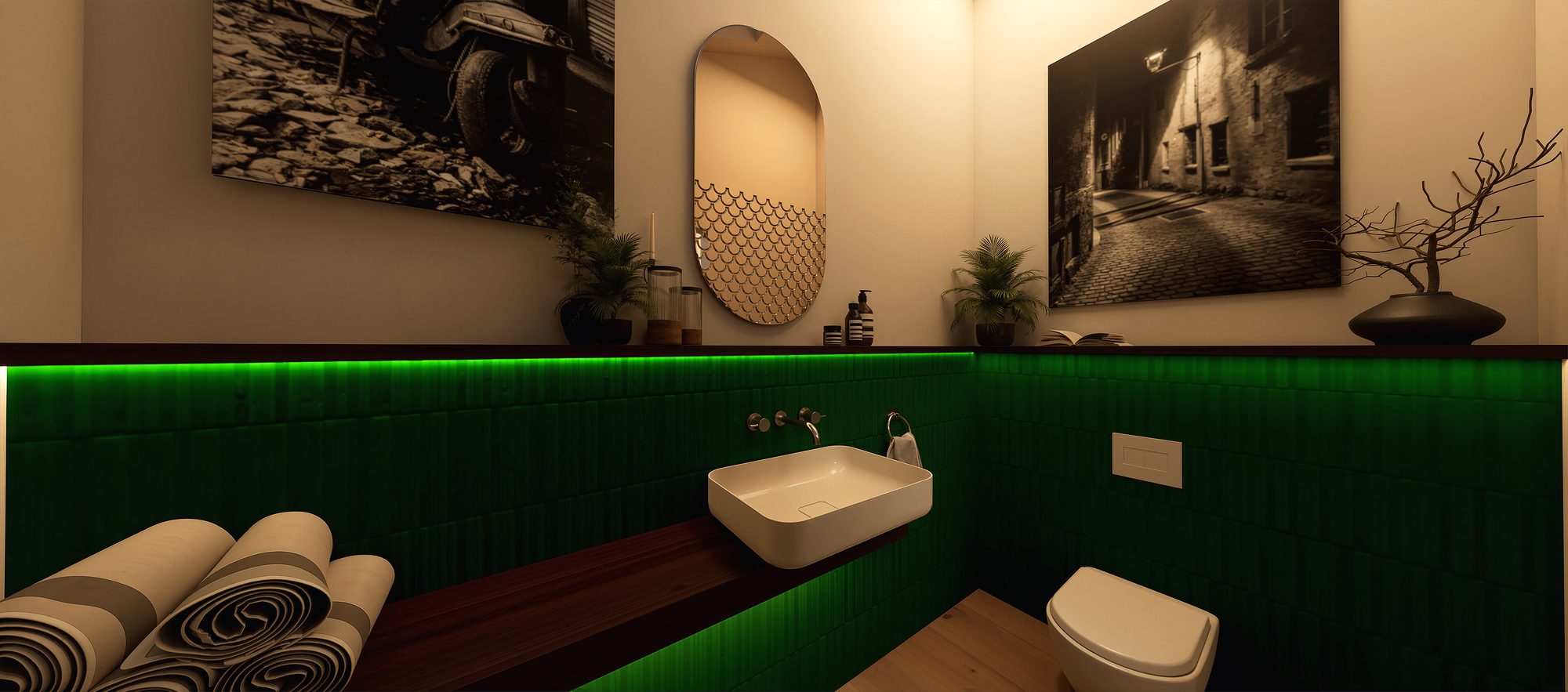
The cloakroom — the one room in the house that is unapologetically itself.
The Plan
The Diagram
The floor plan reads as a single long bar, with the bedroom wing offset to the west to break the visible elevation. The kitchen-dining-living room sits in the middle and opens onto the deck. Vehicles, plant, and storage are pushed to the perimeter, leaving the principal rooms to face south with as much glazing as the brief allows.
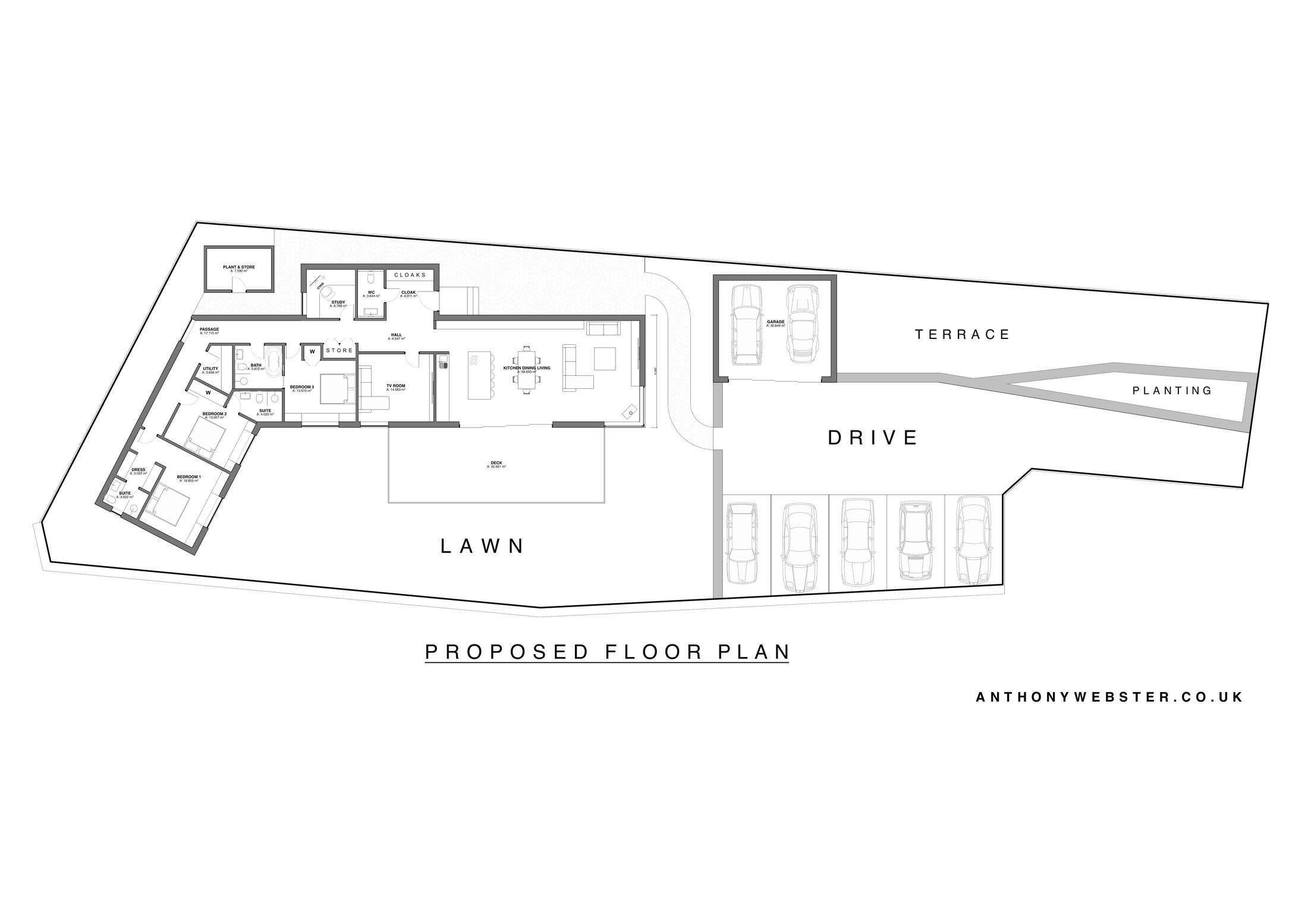
Proposed floor plan. The 59 m² living space sits at the centre, with the deck running off the south side. Bedrooms tuck into the west wing; study, TV room and utility into the east. Garage and parking are handled at the upper level, accessed from the drive.
The Film
From the site as it is, to the house as it would be.
A short film that opens on the site as it is today, then lifts into a flythrough of the proposed scheme — across the south elevation, in through the gable glazing, through the living space to the kitchen, and round to the fireplace, before resolving into the still renders.
The Offer
A self-build with the design problem already solved.
Highwoods is offered at £350,000 with the complete architectural service of Webster Architecture & Interiors Ltd — twenty-six years of residential design experience — included within the asking price. The purchaser is guided from initial brief through to a tailored planning consent: design development, planning application, technical coordination with specialist consultants. Architectural and project management services beyond planning are available by separate arrangement.
In practical terms it removes the most uncertain part of any self-build — the design and consent risk — before the plot is even purchased. Planning and conveyancing can run concurrently. The buyer arrives at the threshold of breaking ground, not at the start of a planning fight.
Asking Price
£350,000
Architectural Services
Included to planning
Tenure
Freehold building plot
Planning
Previous consent for residential
One plot, one design, one offer — but the approach is how this practice works on every project.
The same care, the same constraints-led thinking, and the same eye for the architecture and the interiors apply to every brief, whether the site is a building plot, a listed cottage, or an existing house ready to be remade.